
By Logan Sander
We’ve made several significant improvements to the field station’s land since our last update. Key among them – we’ve begun planting out specimens from our nursery!
Faced with burgeoning stocks of plants that were rapidly outgrowing their polybags (mostly ornamental flowers and edible bean crops we grew from seeds), we decided that we needed to find a space to grow them to maturity. We still haven’t completed our designs for the overall homegarden, but these are mostly plants that grow rapidly, can grow near the house (on land already cleared) and can potentially offer yields before we leave our posts here.
The soils immediately surrounding the field station are infertile, droughty sands and “rotten” bedrock that was exposed during the initial excavations. Before the field station was constructed, these soils would have been several meters below grade – in the humid tropics, this usually means they are extremely low in nutrients. Still, several opportunities presented themselves – the site was flat, easy to access (literally, right out the door), and relatively rich topsoil in abundance 20 meters away in the fallowed fernland. We marked off an area and got to work.
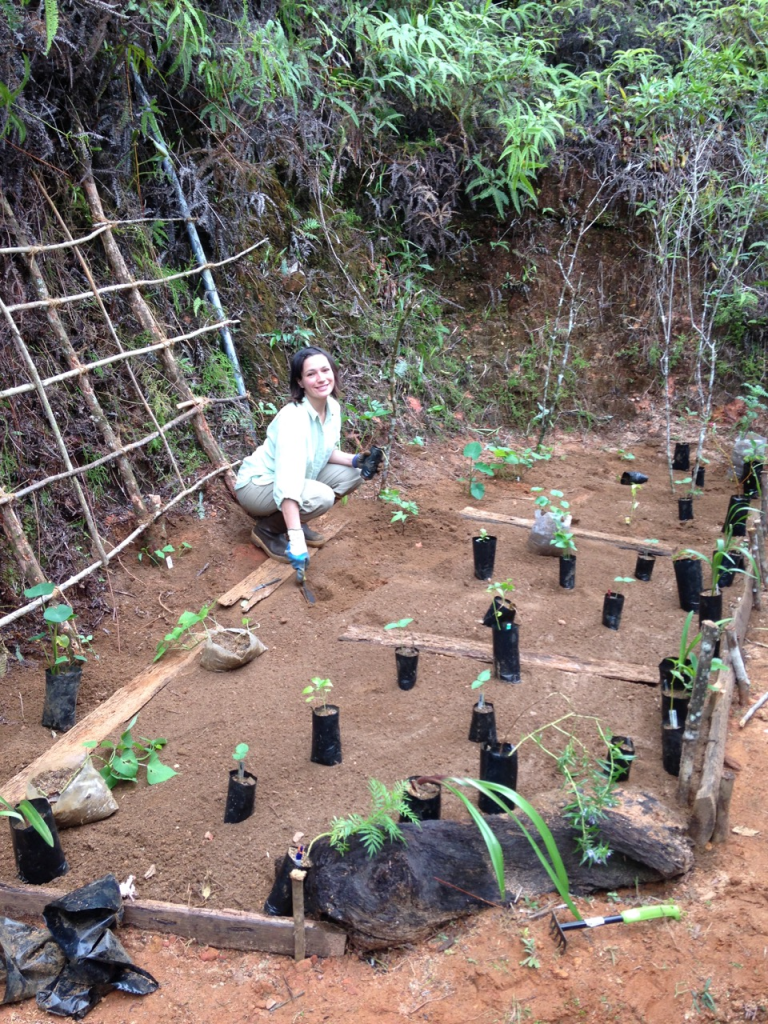
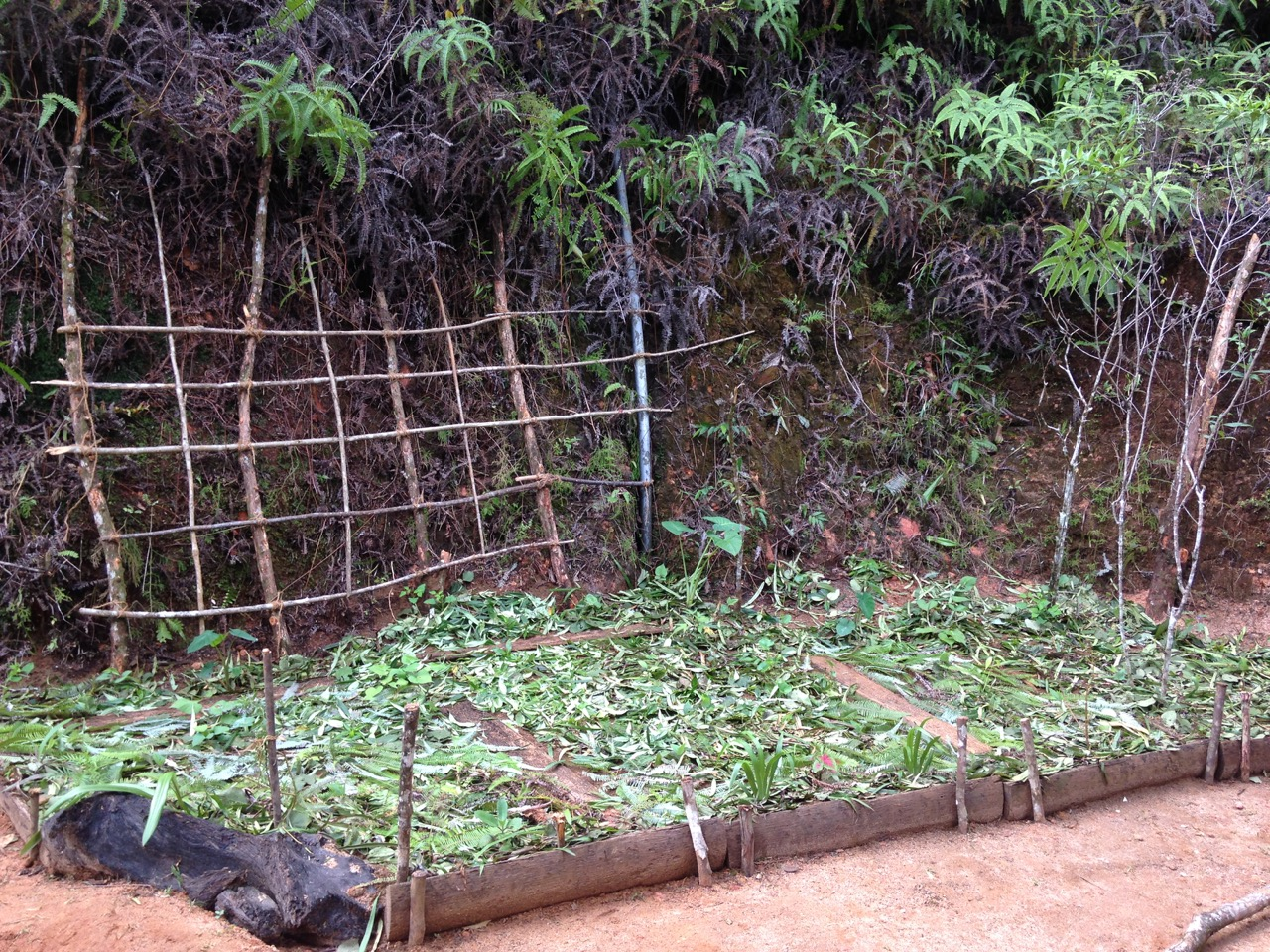
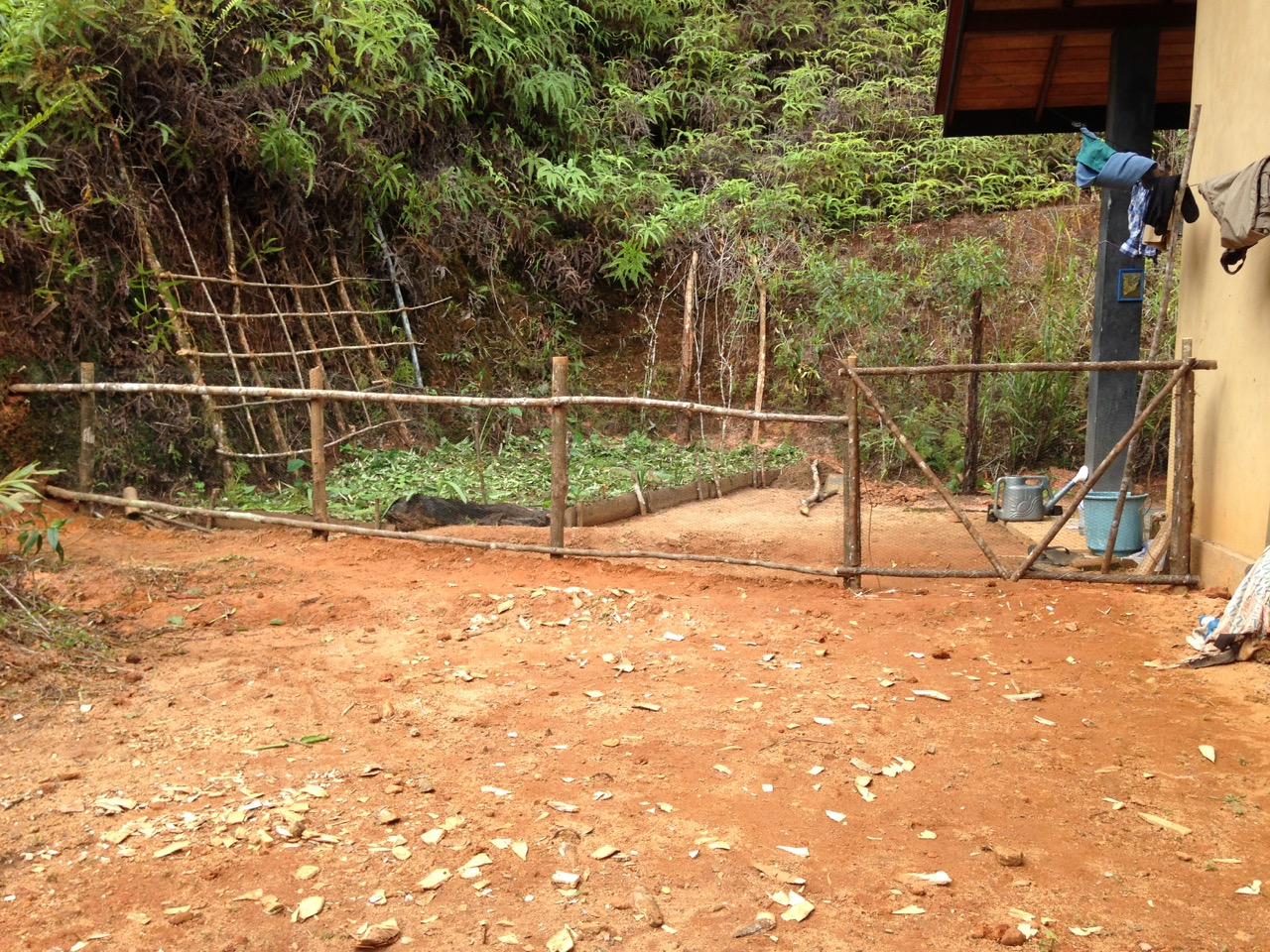
Our “garden” is about 4 x 6m in extent, up against the escarpment that was excavated around the field station. We built a perimeter wall by staking in kitul palm boards and filled the area 6” deep with topsoil (kalu pas, or “black soil”) (see Fig. 1). Against the escarpment, we built wooden trellises of a tree species that may root and continue to grow, creating a living structure on which to grow climbing beans. We needed to protect this area from wild boars, as much of what we hope to plant is the boar’s favored food (as we’ve already learned in the nursery…). On one side this was already taken care of: the escarpments leading to the field station are likely too steep for boar to descend (we hope…). On the other sides we simply extended the walls of the field station with 1m-high fences, creating a narrow protected zone around the field station.
Into our over-sized garden bed we planted an assortment of plants gathered from Pitikele’s homegardens – mostly early-successional food plants with relatively short-life cycles (see Fig. 2). Interestingly, many of these plants are “annuals” in temperate areas, while in the tropics they can live many years as perennials. In addition to the following species, we intend to plant manioc, a few bananas, and other food plants that require defending from the wild boars.
This protected gardening area provides several opportunities for us to improve our homegarden project. As already mentioned, we can create long-term planting sites for those plants that require protecting. Also, this gardening site’s proximity to the field station makes it valuable for higher maintenance plants. This includes those in need of frequent watering (believe it or not, we just had over three-weeks with no appreciable rainfall) or harvest. Additionally, and perhaps most importantly, growing plants right outside our door gives us the opportunity to observe and learn from them before we greatly expand the project.
In fact, just one day after we planted this garden bed, I observed that a kudelo mal (Impatiens spp.) plant had several leaves curled up or chewed apart. This morning, I noticed that all the leaves on plant were either consumed or curled up. Fine silky webs sprinkled with copious amounts insect larvae frass (aka poop) encircled the few remaining leaves. As I inspected the plant, Tillekaratna walked up and explained that the problems were a result of “worms.” He pulled apart one of the leaves and out popped a wriggling green caterpillar. As we’ve been told many times before, we needed to apply ash to these plants to prevent worms. Lesson learned!
This is one of the more satisfying developments in our project to date. Our frequent admiration and inspection of the garden ensures that it will be watered, every inch of ground will remain mulched and any destructive factors will be promptly mitigated. This garden bed benefits both from its proximity to our dwelling (and the aforementioned benefits this entails) and its novelty as our first significant planting effort. Soon we will greatly expand our plantings and our responsibilities will multiply. Until then, these few lucky plants are the show’s main attraction.
Homegarden plants of the “patio’s” initial planting (Sinhala name; English name; scientific name)
kiri ala (taro, Colocasia esculenta)
demas ala (coco yam, Xanthosoma sagittifolium)
makeral (climbing bean)
cowpi (black-eyed pea)
bonchi (climbing bean)
dambala (winged bean,Psophocarpus tetragonolous)
das mal (marigold, Tagetes erecta)
gas lunu (ornamental flower)
battala (sweet potato, Ipomoea batatas)
begonia (Begonia spp.)
goda manil (ornamental flower)
Japan rose (ornamental flower)
kudelo mal (Impatiens spp.)
akapana (Kalanchoe pinnata)
miris (chili pepper, Capsicum spp.)
takkali (tomato, Lycopersicon esculentum) tibbatu (Solanum violaceum)
parabombatu (Solanum spp.)
singhamoku (snapdragon)
gam miris (black pepper, Piper nigrum)
 slpfc.org