
By Blair Rynearson
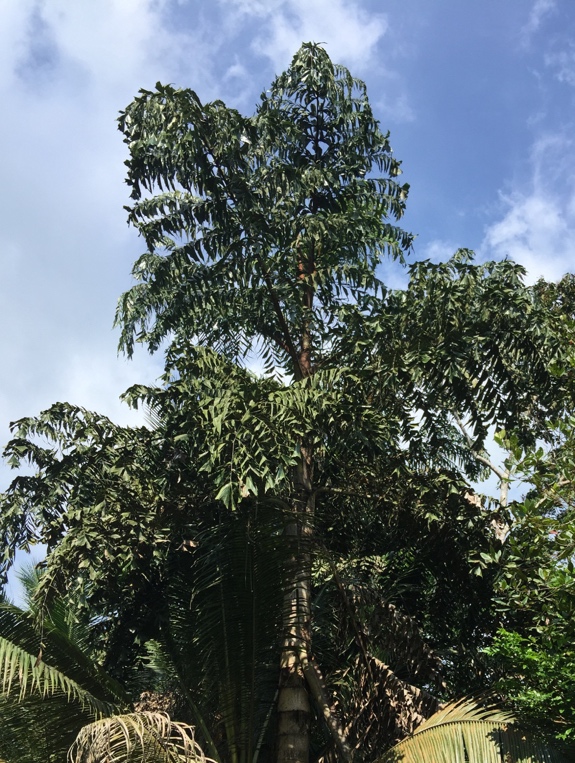
Virtually every visit to a home in the Sinharaja area involves a cup of tea. The tea is almost always served plain, accompanied by a large, jagged brown block of kitul sugar, or kitul “hakuru”. I don’t have much of a sweet tooth and the thought of eating a large white sugar cube disgusts me. But kitul hakuru is different. It’s prepared by boiling down sap from the kitul palm (Caryota urens) (Fig. 1), and has woody, smoky and almost savory notes. There are four varieties of hakuru in Sri Lanka: Pol hakuru – made from the sap of the flower of coconut trees (Cocos nucifera), thal hakuru – made from the flower of palmyra trees (Borassus flabellifer), ukk hakuru – made from sugar cane (Saccharum spp), and kitul hakuru. Most Sri Lankan’s acknowledge kitul hakuru as superior, and it is an essential ingredient in many sweets and foods.
Before tea took it’s place as the dominant income stream in the Sinharaja area, most households earned the larger part of their income from production of kitul sugar and rubber. Women were responsible for collecting the rubber, while the men dedicated themselves to tapping kitul palm. The communities surrounding the Sinharaja reserve are nationally renowned for their kitul tappers, men who make their livelihood by climbing kitul palms to harvest the sap from the flowers. It is not an easy way to earn a wage. Aside from a handful of kitul palms planted in local tree gardens, most of the trees are scattered throughout the lowland wet forest. They are typically found in the subcanopy, located along forest fringes and in gaps. This means that tappers have to walk many miles daily between their home and the location of the trees. To ensure that the flower does not heal over the incisions made for draining the sap, kitul palms must be tapped twice per day. If the flower were to heal over the cut, the flow of sap stops. This means that rain or shine, sick or healthy, the kituls must be climbed and tapped.
Once a mature flowering kitul has been identified, it requires preparation for tapping. The first step is installing the ladder. These ladders generally consist of two large saplings running parallel to the trunk of the palm. At two to three feet intervals, the saplings are secured to the trunk with vines that serve as rungs, most commonly using the stem of a pitcher plant known locally as “bandura” (Nepenthes distallatoria). A mature kitul can reach twenty meters in height and installation of the ladders is time consuming. They are repaired and replaced when the vines dry out and start to crack (Fig. 2).
Who gets to tap what tree is something of a mystery. It seems that different families have established territories. These territories existed well before the foundation of the Sinharaja reserve. And up until this year, Sinharaja has respected this tradition, allowing adjacent communities to tap trees in the reserve. I have heard that starting next year the government plans to suspend this right.


After the ladder is installed, the flower is prepared for tapping. By flower, I refer to a massive inflorescence that can be up to five meters in length. The first time a kitul flowers it produces the largest inflorescence. Subsequent inflorescences decrease in size until the death of the palm. A kitul palm can produce up to ten flowers in it’s lifetime. Kitul usually starts flowering after about eleven to fifteen years of age and flower about once year until the last flower is produced where upon it dies, usually by age thirty.
To prepare the flower for tapping the rachis are stacked against each other and tightly wrapped together with a vine. Some tappers make a poultice from a mixture of plants purported to stimulate production of sap that is applied before wrapping the flowers. The plant species used in this concoction is a well-kept secret. Once wrapped, the terminus of the inflorescence is situated so that sap will drain into a pot suspended below. These pots are just the right size to collect a half a day worth of sap. Twice a day the tapper then climbs the tree, barefoot and without a harness, retrieves the full pot and puts an empty one in its place. The full pot is then secured around the handle of the sheathed kitul knife, where it dangles as the tapper descends the tree (Fig. 3).
The knife used to tap the flower is treated as a sacred tool. It is thin, light and the razor-sharp blade is frequently honed on the branch of a hardwood tree (Fig. 4). A tapper friend in the community has repeatedly told us a story involving a university professor using his kitul knife to cut some wire. It occurred some twenty years ago, but the indignation persists. The sharpness of the blade is important for shaving razor thin pieces from the flower. Skilled cutters can prolong the duration of tapping a flower by cutting less.


 slpfc.org