
By Logan Sander
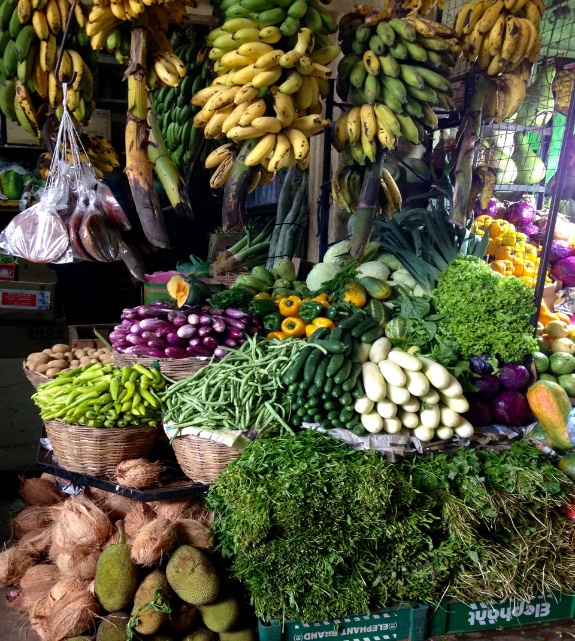
Did you know that Sri Lanka is home to one of the wild ancestors of the banana? We’ve even had the opportunity to try a variety of wild banana still found growing in the nearby forest (Fig. 2a,b). Bananas and plantain (not differentiated in Sri Lanka) are homegarden mainstays throughout the tropics and Pitikele is no exception. Only a few homegardens have no banana plants, while the majority contain a few to over a hundred plants. Owing to this importance, we thought it fitting that the first major planting effort in the mid-level tree garden (Zone 2, from Blog 8 on Home garden Design) be the bananas.

A 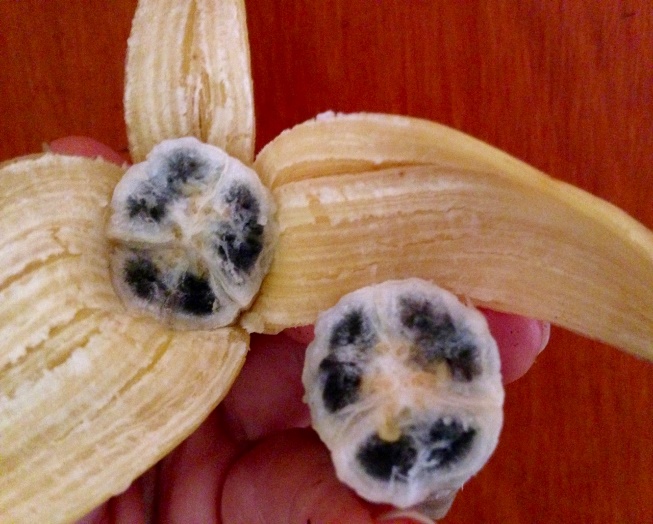
B
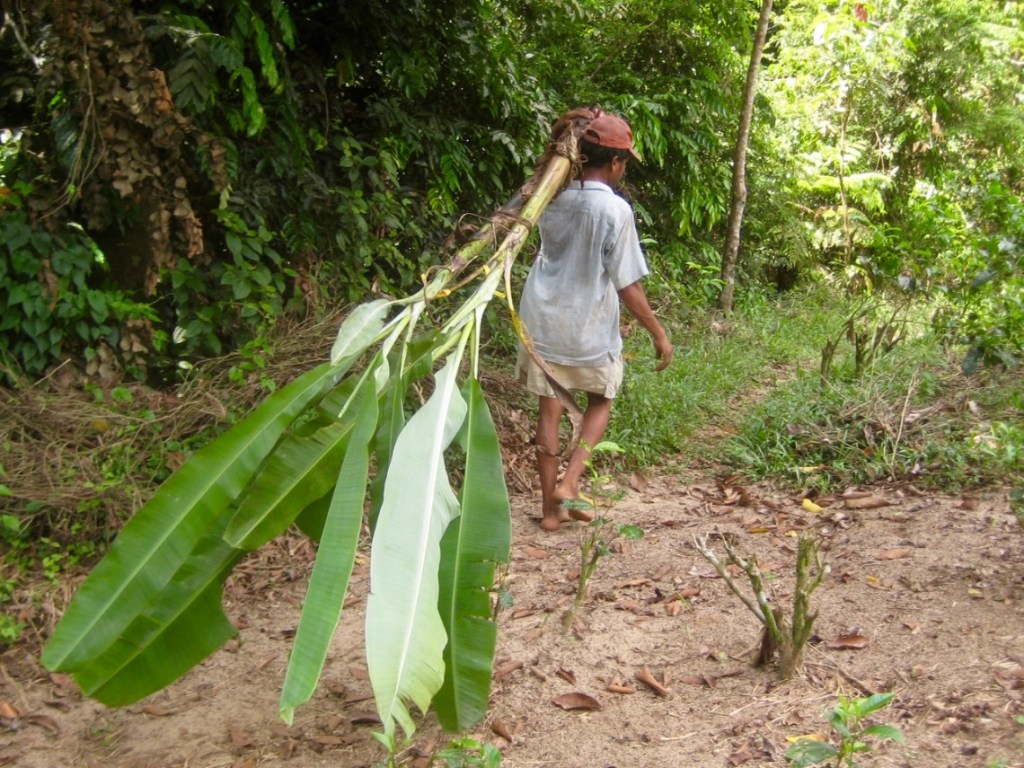
In this region, bananas are generally cultivated on concave slope positions with deep, rich soils and abundant moisture. Only a few small areas of our homegarden match this description, but I believe that with sufficient preparation and attention we can still make them work throughout our site. A benefit of growing bananas is that their leaves and herbaceous stems provide wonderful mulch and they self-propagate by producing vegetative shoots which become new stems once the original tree has fruited and died back (strictly speaking, bananas are herbs as they produce no woody tissues, but I tend to think of them as trees in the homegarden). The fruit of cultivated bananas are sterile (the little black specks found in a banana are the aborted seeds), thus all homegarden banana reproduction occurs from these new vegetative shoots (Fig. 3). Over time, cultivating bananas will create opportunities for other homegarden plants that need this improved soil and the shady microclimate that the growing plants provide. Plus, perhaps because of their familiarity to us, we eat a lot of them.
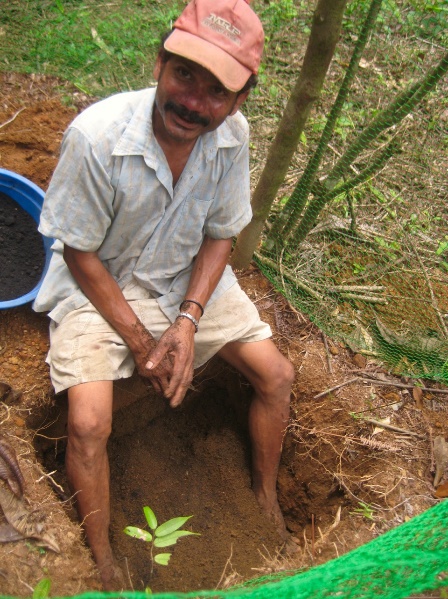
The main challenge to planting bananas at the field station is the poor, droughty soil. Almost everywhere I’d like bananas to be, we have rocky subsoil, exposed during the construction of the field station that is far too nutrient and moisture poor for such a hungry herb. Our local friends report that they would never grow bananas in a few of the locations we’re attempting to, though I have seen large, apparently successful plants on similar patio areas in some of our neighbors’ homegardens. Shortly after arriving here last fall we planted a few bananas next to our patio in an area with this subsoil – after 5 months a few have died and the rest have grown a few small leaves – not nearly good enough results for a “demonstration homegarden.” To get around this, we’re excavating large holes (2-3’ around, 2’ deep) and filling them with a rich mixture of decomposed leaf litter, topsoil from the forest edge and kekila fernlands, and compost purchased from the closest town (Kalawana). It’s not a perfect solution, but with repeated applications of mulch and compost I believe it will support the plants enough for them to grow and produce fruit (Fig. 4 a, b). I’m hoping that over the years the soils around the bananas will slowly increase in moisture and nutrient holding capacity, though I’m under no illusion that we can completely shift the development of what are surely some of the poorest soils in the valley. Also, in a few years the locations of these bananas could be suitable spots to locate fruit tree seedlings, with somewhat improved soil conditions and a good microclimate for establishing a tree.
We (meaning: mostly Tillekaratne) dug 17 large holes across our homegarden for bananas. We were able to locate around 8 of these in areas we’d expect bananas to be grown: along the river terrace near the nursery, and in slightly wetter concave swales. Around each hole we built a small wire-mesh fence (to keep out wild boar) and we filled the holes with topsoil, compost and mulch (Fig. 5 a, b). There is seemingly an infinite supply of leaf litter on our river’s beach near the bridge – each flood deposits several inches of leaves or rodu there. Over the weeks between floods, it breaks down into coarse, sandy mulch. Some days, in the cool mornings and evenings, we haul a few bags of it up to the homegarden to mix with soil and compost. As a completely unscientific experiment, I pushed to include more compost in some of the holes than we were locally advised to do (attaining around a 1:1 ratio with topsoil). Our local teachers thought this was too “hot” for the plants and a waste of compost, a locally valuable resource that, in our case, we are purchasing. I feel that because we’re planting some of these bananas in very marginal soils, we should perhaps invest a little more in these plants.


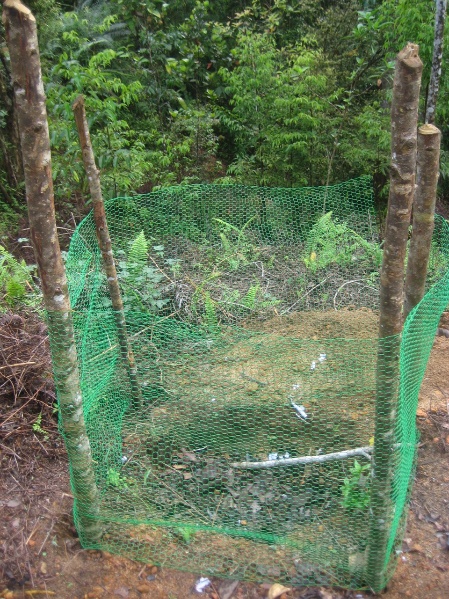
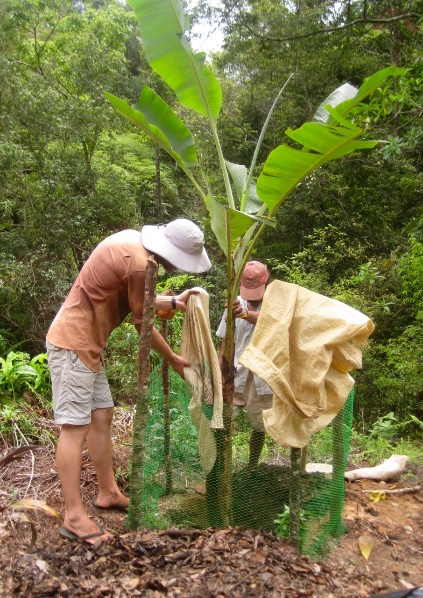
The 17 banana trees we are planting (in addition to the 6 we already have) will include 9 varieties. There are many more varieties throughout the country. Some closely resemble the Cavendish cultivars commonly found in North American grocery stores. Others are much sweeter or have a better texture. One starchy variety that I don’t much care for,“allu kesel,” is served as a curry. The prize, fetching a premium in local markets, is “ambul kesel.” Somie brought us our first from Kuduwa last week. We’ve even heard of a variety that is several feet long! With luck, next year’s fellows will be blessed with a steady supply of tasty ones from our homegarden.
Banana varieties in our homegarden: Ambul kesel; Ambun kesel; Anamalu kesel; Kolikottu kesel; Rat kesel; Rata kolikutu kesel; Sini kesel; Suandel kesel; Sudu kochi kesel (also called Malu kesel)
 slpfc.org