
By Jo Hanle
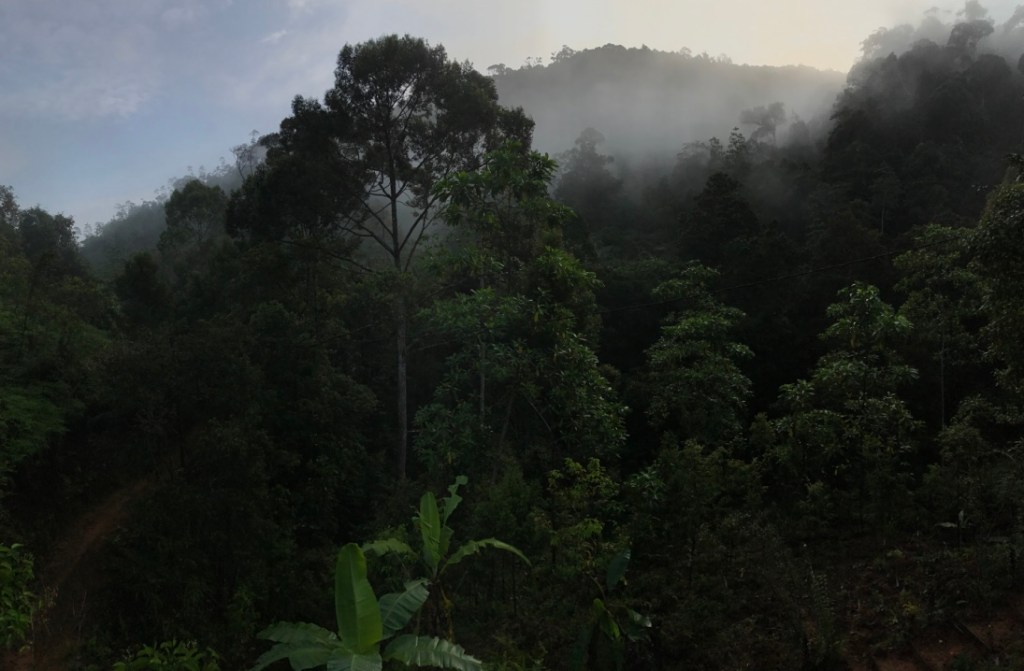
This place is so wet and mild that the bananas seem to unfurl new leaves every week and wings of emergent foliage float over the tree line above our research station, forming a canopy so rough, the forest clearly isn’t water-limited (Fig. 1a). The last fellows left four months before we arrived and our hillside of medicinals, ornamentals, and edibles was covered in weeds. Wal pele, our Sinhala teacher Suresh called them—wild plants. There were the vines and the kekila ferns, the bamboo and the creeping, crescent leaved gotu pele. They pull out easy, except the ferns, and Somé, our caretaker, who helps us make as few mistakes as possible, showed us the local way of maintenance: pull and drop. Nelanawa and drop. Our soil is so dry, sandy, and lacking in organic matter in front of the field station that we feel good about leaving the dead plants on top. We get daily rains, but when the water stops coming from the sky, these weeds will act as good cover to moderate temperature and evaporation. They also help ease our fear of erosion.
Hard showers and abundant evidence of washouts—sodan yanawa—made us nervous. One night the sky thundered so hard the entire hillside shook. It trembled with the bass booms, as if the station sat on the rim of a drum. Where tall weeds haven’t taken over, moss and pitcher plants secure the hillside (Fig. 1b). These plants trail down the red soil, rubbery leaves curling into sealed ewers, which, when they open, show deep red lids. Suresh told us that these pitcher plants only grow near the Sinharaja, they are very special, and you are not allowed to cut them. He showed us to lift open a sealed cup, and drink what it held—clear, pure water.

In contrast, the water at the field station does not taste clear. It tastes like mint and flowers, a wal pele that I’ve only pulled a few times and whose scent will sometimes pass by, just after I tossed away some stems. Torn mango leaves smell like mango, and cinnamon, cinnamon. Cardamom smells like rotting fruit.
But even the weeds at the research station are useful. The creeping crescent, Suresh told us, tastes great chopped up and mixed with shaved coconut, a dish that can be made with many different greens called melum. The sprouts of a ubiquitous fuzzy weed with a pink stem—phonetically “nilembodiya”—can be used to draw out infection in cuts, like our wild plantain. He told us some people chew the small purple-stemmed bamboo, which grows along our stairs, to remove red betel stain from their teeth. hin bowitiya’s three-veined delicate oval leaf is good in curries. Wild rooted bananas and papayas grow well everywhere.
One of our garden medicinals, iriweriya, is growing wild down by the river, a big curtain of fine, stiff leaves (Fig. 2 a, b). Some helped us turn it into a sweet, bitter, and spicy green drink—medicine, good for health, he said for digestion. The leaves of a tree with soft round seeds and wavy margins, kapetiya, make good fertilizer (Fig. 3). Laura, Logan, Blair’s (SLPFC Fellows 2016-17) plantings include insect repellants, stimulants, spices, herbs, and foods, vegetation to boost the immune system, clear out fungus, help digestion, and bring back the dead. We can eat things as small as the sand-sized seeds of kirihenda, a conical purple flower, and as large as papaya, gas labu. Cinnamon lines the path to the river, and citrus girds the slope. The only produce that’s ready to eat now are peppers, miris;—mashed by Suresh with some onion and salt into a nice melum—a starchy sweet potato, battala; and a variety of leaves, kola.


Most of the trees planted by Logan Sander in zone 2—citrus, cocoa, coffee, rambutan, tea, and cinnamon, delicious things and ornamentals—have persisted, and are doing well. Mortality in Laura’s section (Laura Lutrell _ SLPFS Fellow 2016-17) —flowers and medicinals—seems to be only a little higher. But the spacing between the young plants is that of mature ones. We’re confronting the challenge of anyone starting a multi-strata agroforestry plot: growing the ground cover with the canopy. As Klaus Geiger and Meredith Martin put it in their forthcoming study of Pitakele homegardens, the tree garden is in “continuous process of regenerating the canopy while maintaining a diverse portfolio of trees, palms, shrubs, and herbaceous plants.” We’re trying to get that process going from a single starting point, to bring up all strata at once—raise a city in a day. And make sure that the plants that succeed are the ones we want. We have begun our inventory, seeing what worked well and what didn’t, and what we’d like more of (Fig. 4). We’re fertilizing and adding compost, and half way through a complete inventory. The plants that got compost a week ago are already reaching up new green shoots. We like the legacy of the last fellows, and plan to focus on building more groundcover to shade out those wal pele—and keep making this soil richer.


Latin species names for Sinhalese plants named in this blog
Battala: Ipomoea batatas
Bombu: Symplocos cochinchinensis
Hin bowitiya: Osbeckia octandra
Iriweriya: Plectranthus hadiensis
Kekila fern: Dichranopteris linearis
Kirihenda: Celosia argentea
 slpfc.org