
By Juliana Hanle
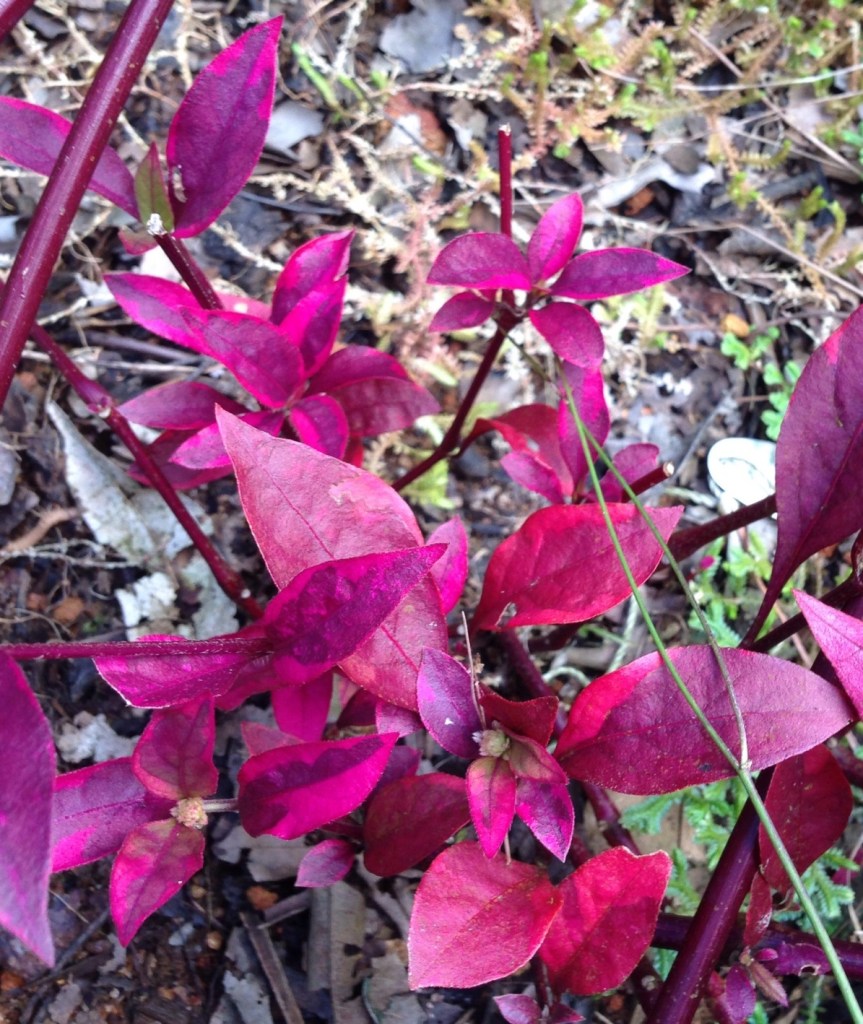
We’ve fertilized, applied compost, trimmed the bananas, built a trellis, weeded, and installed new planting beds. We cut the wild orchid growing below the pitcher plant slope behind the research station, and pruned the dill, roses, and kirihenda. We cut back the tree of life and harvested papaya. We rid much of the garden of bombu and peeling back weeds revealed a coat of moss in front of the research station. The bananas are so lush they look like man-sized green flowers. The hibiscus bloom, red and pink flowers opening like umbrellas. We’ve planted clippings of dill and deep purple mukunu waena (Fig. 1). The rain abated, we discovered it takes three hours to water in the morning, and the rain returned.
Purple-rumped sunbirds and a pair of bulbuls are nesting in the medicinal garden, and crested serpent eagles in the large hora (Diptercarpus hispidus) tree across the valley. We found knuckle-sized cream eggs tucked in the round basin of a coconut husk, protecting an anthurium along the road. Yesterday, a pair of lizards, navy and green with neck scales tipped in gold, dug a hole for their eggs at the edge of the station’s walkway, against the concrete lip. They bobbed their heads in challenge when I walked by.
We prepared a Christmas barbecue for Suresh and some friends–members of the most popular band in Sri Lanka, he said–last week, roasting the chicken on metal stakes meant to pin fencing to the ground. We made cookies with roti flour and jaggery, cloves, ginger from the garden, and cinnamon bark so fresh we could tear it with our fingers. The members of the most popular band in Sri Lanka seemed to think it wasn’t bad. The garden is starting to feed us. Manioc, papaya, chillis, and tibatu, bitter melon. A pineapple is ripening on the back walkway.
Tommi, Some’s dog, gets plates of rice outside the kitchen, and one day a dragon–a land monitor lizard of genus Varanus, the same as the Komodo dragon–came by and ate it before he could.
Luke went down a gem mine last week. Suresh took us to a friend’s family’s property. The owner, Suresh’s friend’s uncle, and four men, worked around a square shaft forty feet deep, next to a slow river (Fig. 2). At the bottom of the hole, a tunnel ran 15-20 feet towards the waterway. Men below plugged seeping water with bales of dried kekila fern (Dicranopteris linearis) and sent up buckets of mud on a pulley. Two pits of mud lay nearby, mud that had been sifted, and mud that hadn’t. They wheel up the mud like water and then pan through it, looking for gemstones. Topaz, Suresh’s friend’s uncle said, would be very nice. A single gem had already paid for the seven months they had spent on this mine. The gems lie in gravel beds, lens-shaped, river-deposited, between quartz and other, less valuable, minerals. The owner and his men planned and constructed the entire system themselves, including the timber holding the earth back from the mine, and the frame Luke and Suresh and all the workers moved down. It comes from the property–whatever trees that are permissible to cut. We’re in Ratnapura district, and this is gem country.

We spent a day getting manure from Kalawana. We spent a day cutting kekila and digging the soil out from under it–moist, brown dirt, filled with decaying plant matter, good for seedlings. We spent two days sifting that soil free of roots and rocks, pressing it through a mesh-bottomed frame. According to Tillekaratne, not unlike tea factory workers, sweeping leaves across drying racks. Then we watched it turn to mud in the rain. Sifting mud is the work of fortune hunters and gardeners. Tilleka, who has a simple solution to everything and repeats Sinhalese words at us until some meaning penetrates, supervised. He put together a seedling bed using kitul boards cut last year. He made a trellis for the bulat and gam miris, slicing Alstonia macrophylla poles from the jungle with singular cuts, and driving the cross beams directly into the steep hillside. We accomplished the little labor of securing the slats on top. Now, the bulat (beetle-nut vine) and gam miris (pepper vine) are growing well, reaching their top tendrils across the boards, and pitcher plants hang from the sides (Fig. 3).

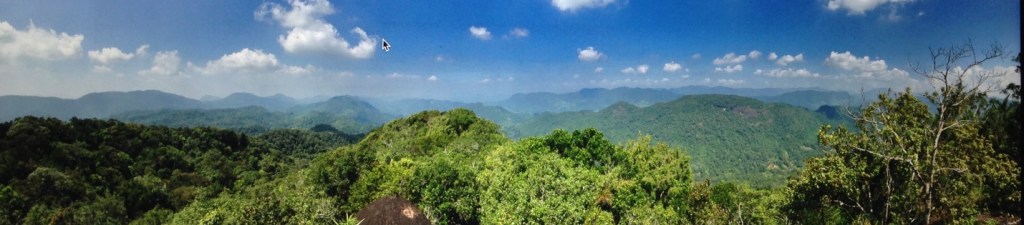
Returning from a visit to the Sinharaja rain forest in early December (Fig. 4), we started to follow a track that cut along the ridge between the centre’s entrance and our research station, quartering our walk. We had directions–cross a tea garden, then jungle, then another tea garden, then a home. Ask directions at the home. But no one was in – we had passed the owner at the last tea garden. The trail divided and became an animal track. The animal track divided and became a mountain stream. We followed it through second-growth rainforest, then stands of Caribbean pine planted for resin tapping and timber, with a thick undergrowth of dry-leaved batticola (bamboo). The pine poles all tilted with the prevailing wind. This forest is why we hear the Ceylon blue magpie, a bird only found in the Sinharaja, whistling outside the research station every morning. Our forest guide told us that as the young jungle around the Sinharaja’s core ages, it’s becoming dense and the jungle birds are moving into the village. Downslope, we hit the open road.
By the third week of December, our garden badly needed trimming. We cut many plantings back to stems. When Some’s family visited on a school holiday, his wife, Piyaseeli, took a moment to clear the medicinal garden. Piyaseeli cut the tree of life. She cut the blue-flowering katarodu. She cut the purple mukunu waena. They had been growing to excess, tall, slender, and falling where they could no longer support themselves. She motioned quickly to show that a little pruning would help them grow full and low. The dill, on the other side of the garden, was frothing over the fence. Taller than us when pulled straight, it bowed like horsetails. I cut it and the roses, which were climbing into the patio. Piyaseeli turned the bouquet of dill into cuttings that we placed directly into the soil, where the ground needed cover. Some’s two younger children, Nethmini and Amal, set to making holes and bundling stems and swiftly lined the side patio. After a few days, the cuttings took root and began to open new leaves. Over the fence, where bombu had stood, liberated thebu spiraled up. Given a little water, a little light, things grow ferociously here.

Plant names: thebu– Costus speciosus; pranagiwa – Desmodium gyrans; katarodu – Clitoria ternatea; bu hora – Dipterocarpus hispidus; mukunu waena – Alternanthera dentata; bulat – Piper betel; gam miris – Piper nigrum
 slpfc.org