
By Juliana Hanle
The spot-winged thrush sings early and the magpies follow. Purple-rumped sunbirds make the same weeping sounds as sap boiling in burning twigs. The yellow-browed bulbuls are loud and sweet and the black-hooded oriole’s call bounces thick as honey. The dark-fronted babbler is barely audible, the black-naped monarch hisses and trills, and the endemic, globally vulnerable Sri Lanka blue magpie chinks, crackles, whistles, and croaks. I’m listening for birds in the home gardens, tea gardens, and fragments of second-growth forest, recording all that I hear and see to capture information on the birds’ use of the buffer zone of the Sinharaja. Following their voices is like untying a knot. If the sounds were a ball of cords, each would vary in color and texture along its own length. You can’t even grab the ball–it’s rolling by, you can’t stop it.
The Sinharaja is home to well-known and well-studied mixed species flocks, dozens of birds of varied size, color, and habits that move together, raising and hawking insects. Bird waves arrive like wind: you can hear them approaching, then they’re there, bells and cackles, and then they pass. The babblers lead flocks that stretch from ground to canopy.* The velvet-capped, fish-tailed Sri Lanka drongo swims in the air. It absorbs light and falls from forest edges like quick shadows and parts from stream banks like drapery. The flocks seem to follow the river and forest edge and range wide, tens of meters.
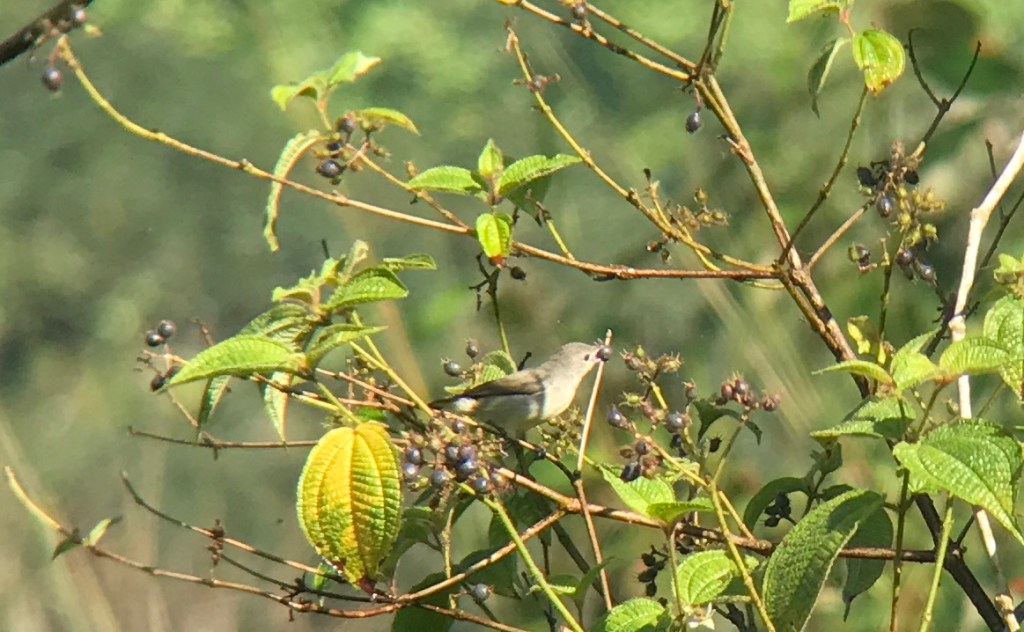
Suresh told us that the blue magpie is shy because of a banding program. It’s bold at the research station. They pluck at the caterpillars we haven’t pulled from the bananas. They move strangely, leaping lightly but forcefully, bouncing up trees. In pairs, the magpies are in body conversation with each other. One hops higher than the other and then is leaped in turn. They cross to a new tree. This private conversation takes place within its in-flock movements–a softer, larger negotiation. The flock birds all move in hopscotch: minivets, small oriole-colored birds that pivot and dive, bulbuls that cut straight lines from tree to tree, flowerpeckers that swing quickly (Fig. 1), and babblers that sail wings flared, tented.
To set up survey points, I walked Pitakele’s jungle edges and found them riddled with paths. We’re in a one-road- town–but traffic swings all across and along the valley, following contours and ravines. Walkways cut up and across the hills to bondura-wrapped kitul trees in patches of second-growth rainforest, follow irrigation pipes to high tea gardens, and reach into rubber stands, where leaves have turned red and there is a singular fall.
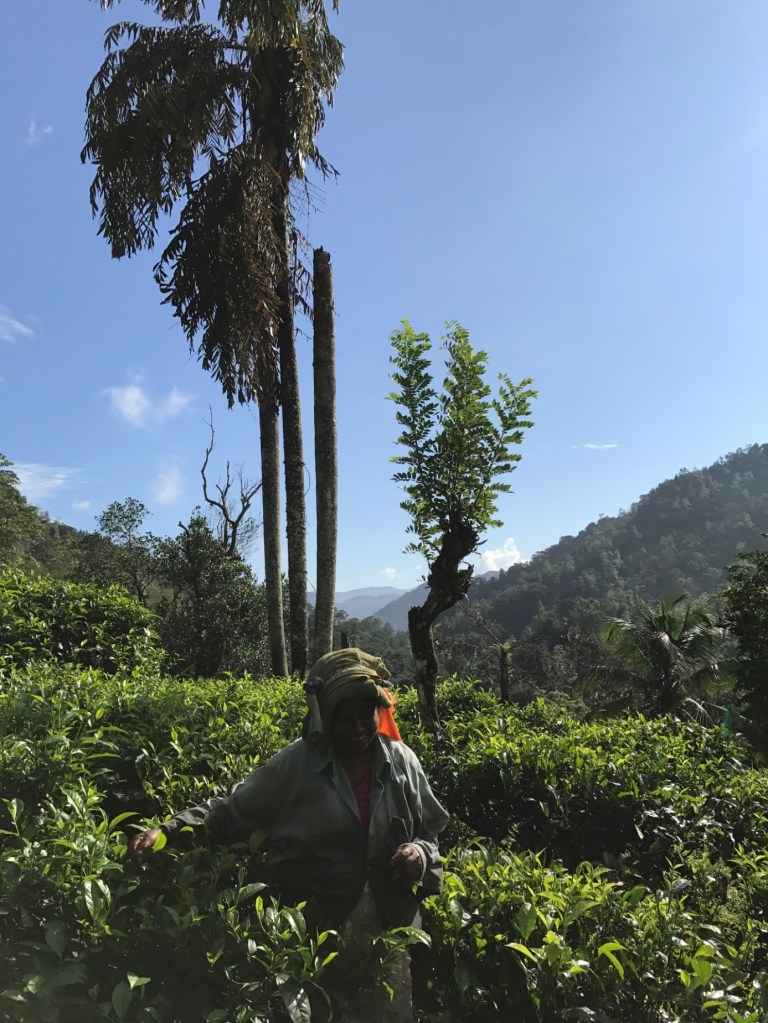
In the canopy men tap kitul and cut breadfruit, and in the understory someone walks across a jungle ridge, someone taps rubber, and, far from a home or tea garden, someone answers a phone. Butterflies, ashy and butter-colored, black and phosphorescent blue, flicker like leaves falling sideways and up. Monkeys walk through the forest top, bending trees into each other. From the tea slopes you can hear much of Pitakele valley. A family sifts coffee beans below. Premewati picks dalu (Fig. 2). Boys play in Neshanti’s yard, facing off with sticks. Someone is playing music in Tilleka’s house, in Ajit’s house, in Muturanga’s house, in Rohini’s house, in Romanis’ house. Someone is hammering, someone is sweeping, a baby is crying.
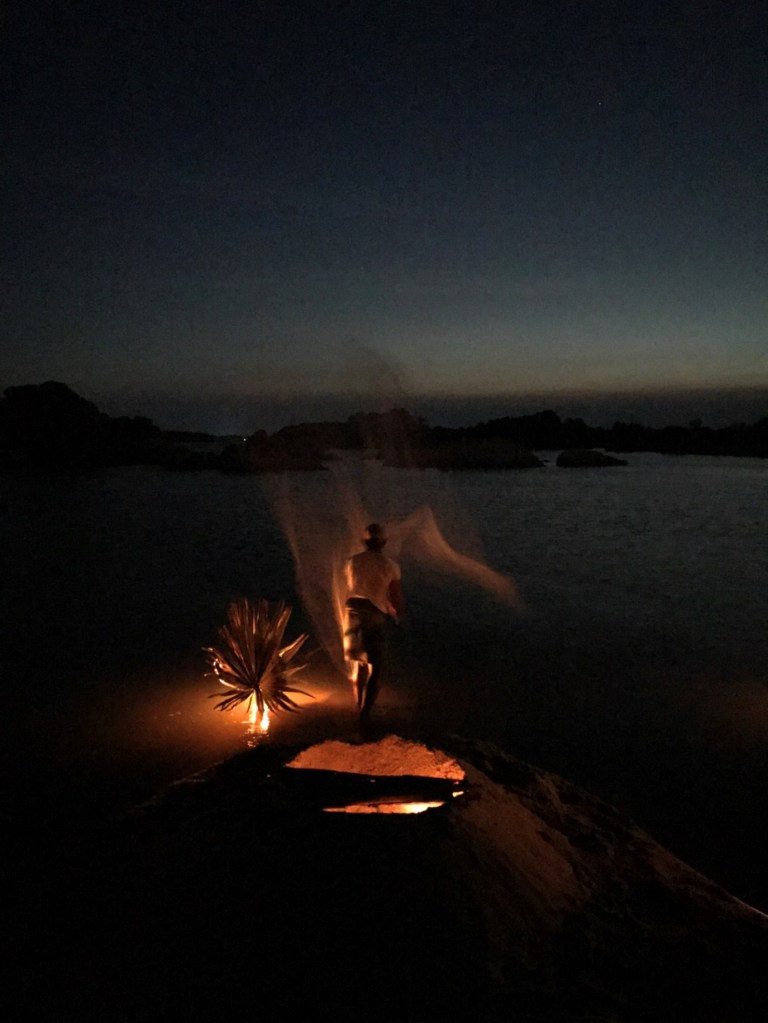
There is something pulling about the dry season, the lack of rain, this waiting for the humidity to fall. We’re hanging. Luke and I went to Arugam Bay on the east coast, where everyone spoke Tamil, not Sinhala. At night, the seafront lagoon was ringed by fire. The locals hung small kerosene lamps on partially submerged sticks and threw weighted nets out into their light. A twist opened the nets’ hems out in neat, wide circles (Fig. 3). The men reeled them in slowly, pulling and twisting the cord. They gathered the bottom and shook it over a sand mound containing a tiny bottle with a wick and flame and covered by palm fronds. Prawns, a few each throw, remained within the circle of light. Mohammed, who runs a seafront shack and showed us his brother-in-law casting, said that when the tsunami came ten years ago, he and his family lived by climbing a palm tree. Twenty people rode out the wave in that tree.
One night a few weeks ago, a troop of young men came along the path to the research station. They spoke briefly to Some and then crossed the river, to the next house at the end of Pitakele, leaving three bookmarks bearing a man’s face and a symbol. They came about elections, Some told us. Last Saturday 11 million people voted in Sri Lankan local elections, the first since a national vote in 2015. It became a referendum on the national government. Signs and decals were everywhere, political ads across car rear windows. In Colombo, newspaper stories included corruption in the former government–a missing nine trillion dollars–and electioneering. A couple angered residents of a remote village when they flew a helicopter in to canvas. Another story covered a quota that required a quarter of local candidates to be women. A week before the election, the line to register to vote at the Department of Registration of Persons ran out the door at eight in the morning.
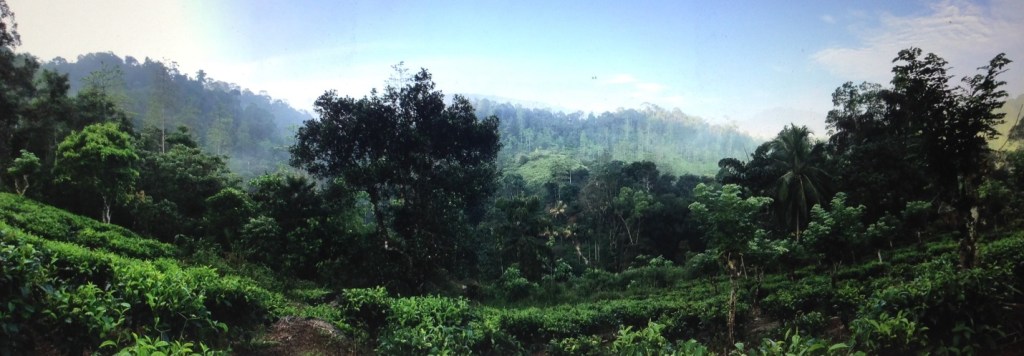
Pitakele residents voted at the Montessori elementary school in Kudawa. On Sunday morning I heard triumphant hoots from my place in the tea. The election results came in and Sri Lanka Podujana Peramuna (SLPP), the party led by Sri Lanka’s former president from 2005-2015, Mahinda Rajapaksa, who governed during the last four years of the civil war and left power under the shadow of corruption, won nearly 41 percent of the vote in local elections, more than ten percent more than the next party and more than twice as much as votes for the party of the current president. The SLPP immediately called for the dissolution of parliament. As someone down the road put it, there seems to be a national rising against the government–the people want a strong leader. I heard how Pitakele was happy and I heard leafbirds and hornbills and bulbuls and monarchs (Fig. 4).
*Kotagama, S. W., and Goodale, E. 2004. The Composition and spatial organization of mixed-species flocks in a Sri Lankan Rainforest. Forktail 20: 63-70.
 slpfc.org