
By Chandni Navalkha
The community study I am charged with here has been about trying to learn what daily life looks like, and how people’s lives and livelihoods have changed from two decades ago when Cynthia Caron, then a graduate student at Yale, came to Pitekele. People still remember her – they often ask me “do you know Cindy? We were children when she was here!” They remember how she did all of the work that villagers did – working in the rice fields, making meals, tapping rubber, picking tea (Fig. 1). With only a few months here, and without the language skills she had, I feel that my own time in Pitekele has given me just a snapshot of the things that have changed and the things that have stayed the same.
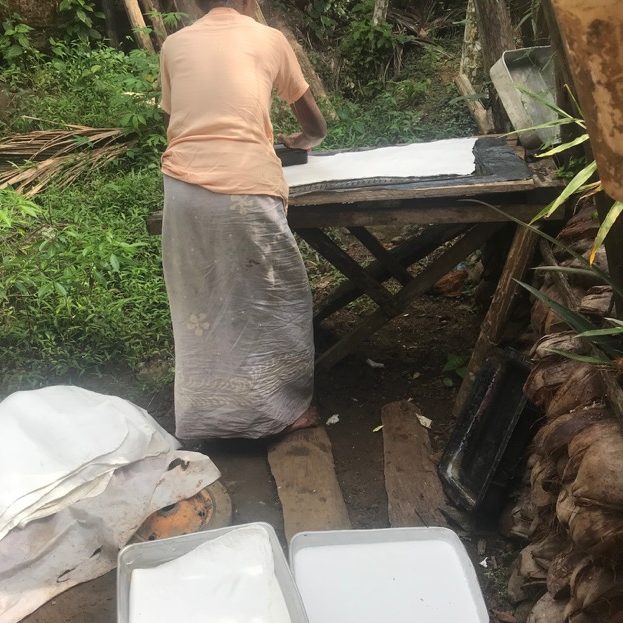
While people rely less on the forest than they did even when Professor Caron was here, there are still brief glimpses of people’s use of forest products and past livelihoods. I’ve been given gifts of dummala or resins, which are gathered in the forest usually when men go into the forest to tap kithul trees they have bought permits for. One day at a friend’s house for tea, her grandmother gave me some dried wild cardamom (enasal), an understory plant that grows in the forest, to try (Fig. 2). It tastes nothing like cardamom in India! While few people in the village grow or tap rubber anymore, one household still does and let me roll out some rubber sheets with her using an empty glass bottle. I’ve helped pick tea, choosing which young shoots to pick and which to leave; I go slowly, but people here pick leaves so quickly that the shoots cut deep scratches and sores on the edges of their fingers. Nobody grows rice anymore; with tea incomes, low yields, and animals like sambar and wild boar raiding their fields, it’s become cheaper to buy it than to grow it.

Home gardens have stayed largely the same, a treasure of coconuts, edible leaves, native and exotic fruit trees that are unique to each family. People here don’t buy fruits – they wait for them to ripen on the trees, or in the fronds of a pineapple. I’ve eaten a fruit they call nan-nan (Cynometra cauliflora), a strange kidney-shaped creature the colour of an old potato which grows on the trunk of the tree. Beli or the bael fruit (Aegle marmelos), which looks more like a pumpkin than a fruit, is sweet and seedy, its roots and leaves used as ayurvedic remedies for stomach issues. One young man in the village has adopted a style reminiscent of permaculturists and urban gardeners, growing leaves and vegetables in beds made of tires. Another garden is more than a century old, its hundred coffee trees serving as a reminder of what people grew in the time before tea.

I’ve also slowly learned more about village customs and traditions, and have been able to participate in several over the past two months. One of these, stemming from the time when people cultivated rice, is called samaaja sewaya or joint work. Villagers come together for particular tasks, like building a small temple or constructing the foundation of a new house for a village member. These work days can be on national holidays like Poya, the full moon day of each month; or on designated days where people take time off from picking tea to help construct or cook. Men take on the heavy construction tasks and women prepare tea and food; my contributions were helping to gather sand from the riverbed to make concrete blocks and peeling and cutting endless onions and potatoes for a huge lunch (Fig. 4).

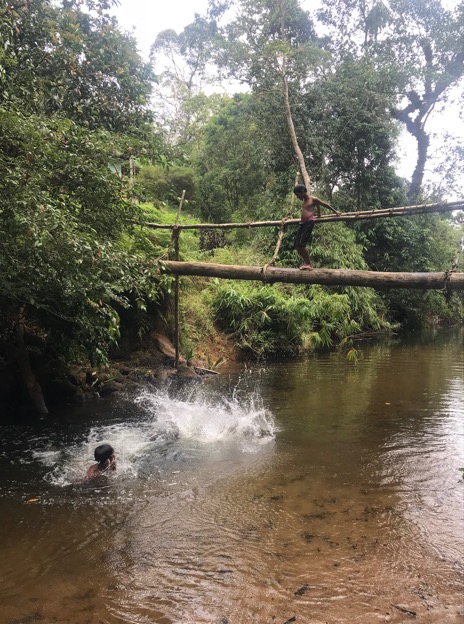
The environment too has changed. People talk about how in the past, the river was 10 or 15 feet deep; it was considered dangerous to swim in in most places. They describe the climate as hotter than before. Most of them attribute these changes to the deforestation that took place in Sinharaja in the mid-1990s, just after Professor Caron left, when the state timber corporation logged parts of the forest for timber. Now, the river is only high just after a storm; in a few hours it returns to a swimmable level (Fig. 5).
As I think about what people have told me during the months I’ve spent here, I can’t come to easy conclusions. Life in Pitekele is eminently practical, which means that everyone does things differently based on their needs, wants, preferences, histories. As I start to analyze the data I’ve gathered over the course of interviews with more than 40 households, I try to keep this in mind.
 slpfc.org