
By Asha Bertsch
Inventory was completed a month ago! Every tree, shrub, and semi-perennial herb has been measured and catalogued in the hopes of generating a long-term dataset documenting the unique growth of a Sri Lankan home garden. There’s a bit of data to clean up, tags to be reassigned, and some confusing labeling to be sorted through, but all said and done, a pretty successful effort.
Jo headed back to the states and I am getting ready to begin conducting interviews. I was a bit daunted by this at first, with so much of the community still unknown to me. Luckily, these past weeks turned out to be quite the opportunity for socializing! Schools are letting out for the season and each one is putting on their end of the year performance. Jo and I were invited to three of these (Fig. 1). We were also invited to several events at different temples and a number of subsequent lunch dates. Without knowing how to say no (or wanting to really), the past weeks here have been chock full with monks, children, sweets, bus rides, and loads of new pals.
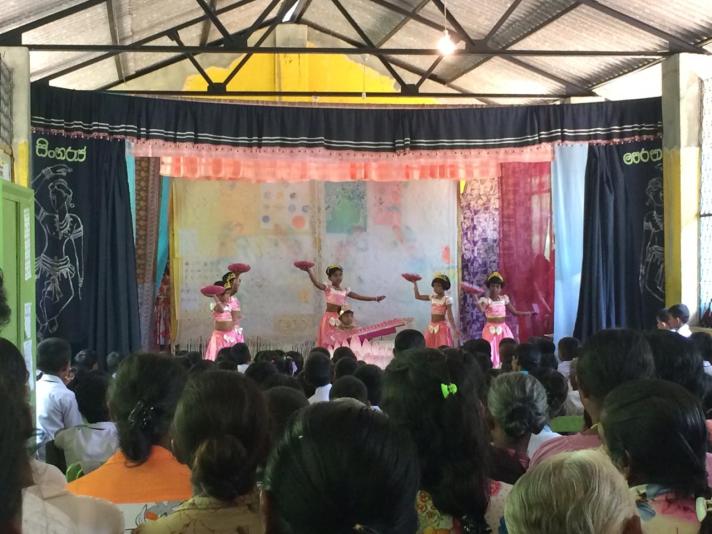
Although there is still a lot of work to be done around then field station, it’s important to take time to be part of the community here. These are the people who are teaching us about their gardens, sharing generations of knowledge, and offering us seeds and cultivation tips. They are generous with their time and provide plenty of patience with entertaining our seemingly obvious questions and our blundered attempts in Sinhala; and they are curious about who we are and where we come from. We are guests in their village and we make every effort to show up for their invitations to share their lives with us. The rewards are many, as you’ll have a chance to read in Jo’s blog post.
After a whirlwind of community events and a trip to Colombo for Jo’s send off, things here have calmed down quite a bit. I’m now diving into some of the more routine maintenance tasks of the garden. Taking inventory measurements was a great opportunity for us to check in with each plant individually and see what issues have come in the months between now and the departure of last year’s fellows. Some trees have fared better than others, either because of site conditions or just the need for a little more attentive care. Palu (betel nut – Areca catechu) palms planted in high shade areas have not fared well and may need to be transplanted to areas with more sunlight. The singhamoku (snapdragon – Antirrhinum spp.), a medicinal herbaceous shrub with ornamental flowers, has proven to be quite aggressive and has taken over much of the garden bed in zone 1. The “dill” and rose bush have acted similarly. There’s still a lot of open ground to cover, so I’ve been spending the days transplanting these species into more open areas where they won’t be at risk of crowding others. Clumping grasses are also ready to be divided, and unruly shrubs ready to be pruned and their cuttings propagated. What were originally four large clumps of vetiver grass (Chrysopogon zizanipoides), I’ve divided and planted in contour along the hillside in hopes of slowing the rate of erosion (landslides are not uncommon on this topography). Similarly, the numerous excess stems cut from many of our flowering shrubs make for viable cuttings, and after putting these in polythene bags with soil, our nursery has literally doubled in size overnight. Ah, vegetative propagation, the gift that keeps on giving.
It has also become clear that our banana trees are in imminent danger, due to their distance from the house and the ura’s (wild boar) preference for their fleshy stems as a midnight snack. They have a taste for fleshy tubers and have a keen nose for our kessel (banana – Musa spp.), manyoka (manioc or yucca – Manihot esculenta), and batala (sweet potato – Ipomoea batatas). With the manyoka and batala only a few feet from the house and human activity, they seem to have been spared for now. But, most of the kesel trees from last year have already fallen victim to the elusive porker – although they leave a mess of evidence behind, I’ve still never seen one! We’d hoped an increased presence of people would frighten them away, but since we’ve arrived there have been many more casualties. It’s pretty clear that if we want to have bananas, we’re going to have to grow them closer to the house and likely need to construct some sort of additional fencing. But this is the learning process of cultivating a home garden.
The right combination of timing and placement are learned through generations of trial and error, just as we are experiencing it here at the field station. Each home garden in the village is the result of years of observation and careful fine-tuned adjustments. Each unique and telling it’s own story. Everyone has a carefully curated collection of vines, shrubs, trees, herbs, epiphytes, grasses and ground covers, each puzzled into the horizontal and vertical spaces surrounding the home. Of course this assemblage of growth habits can fall into place naturally, but in order to look the part and maximize functionality, it takes some fine tweaking.
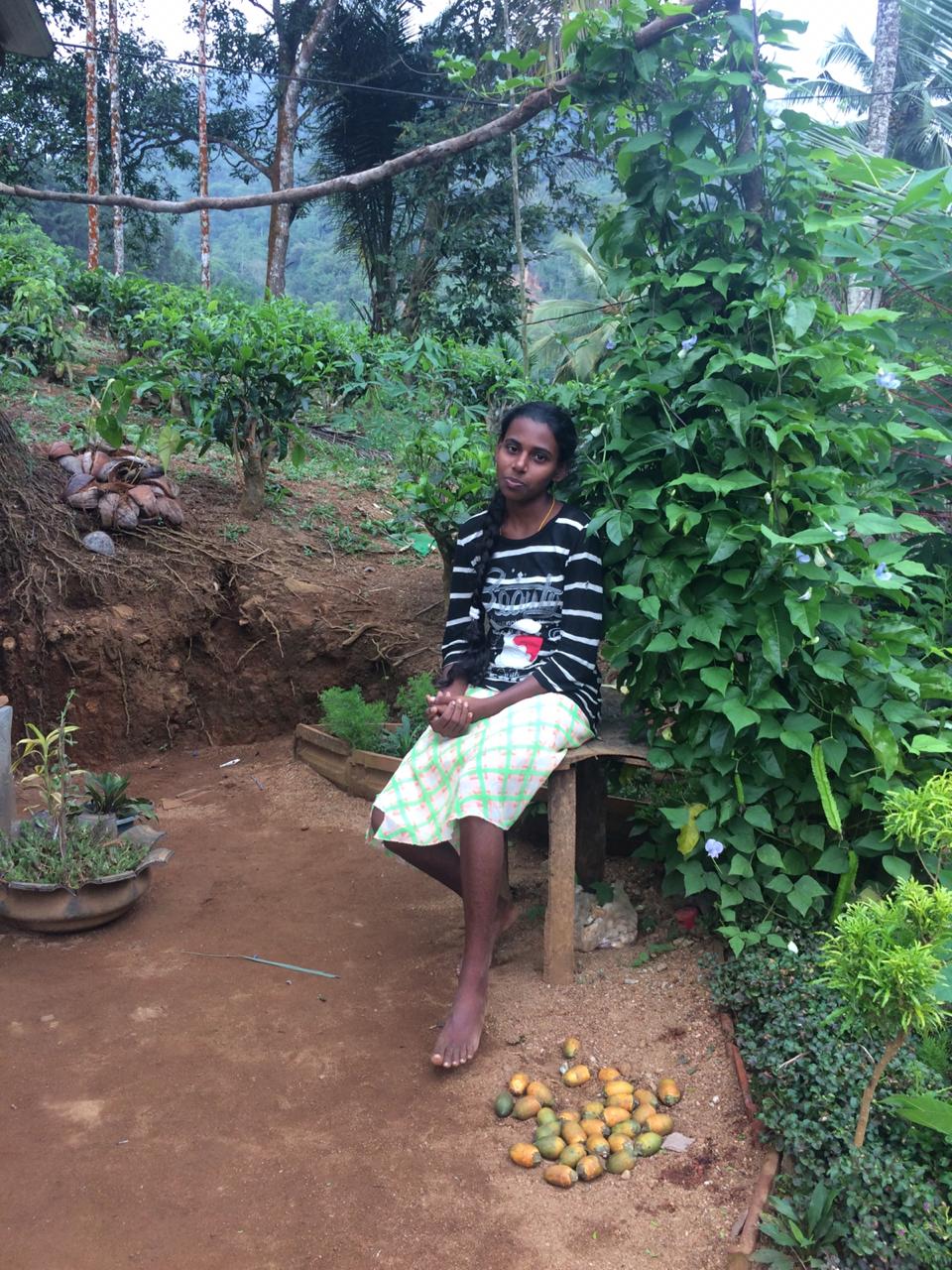
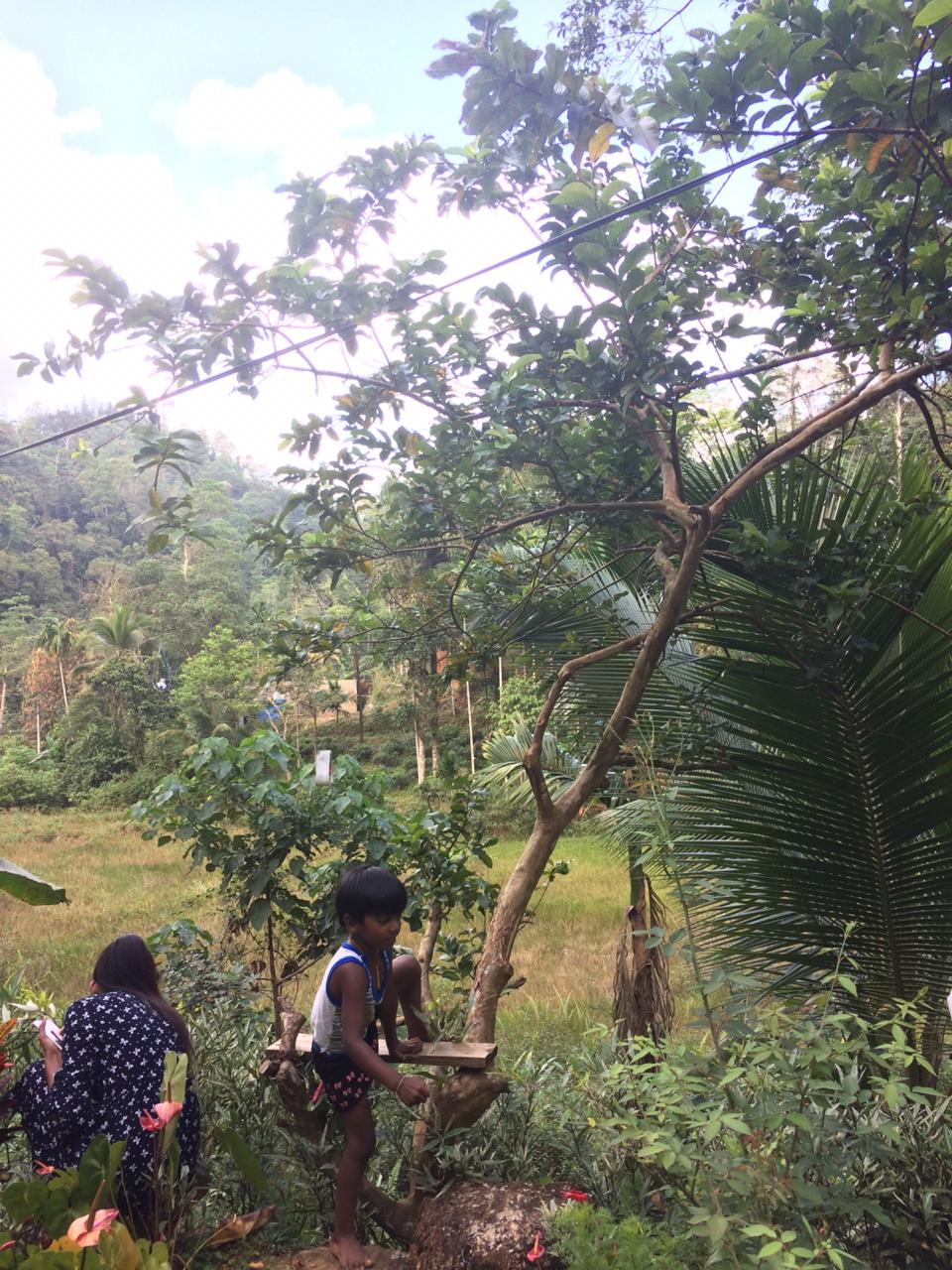
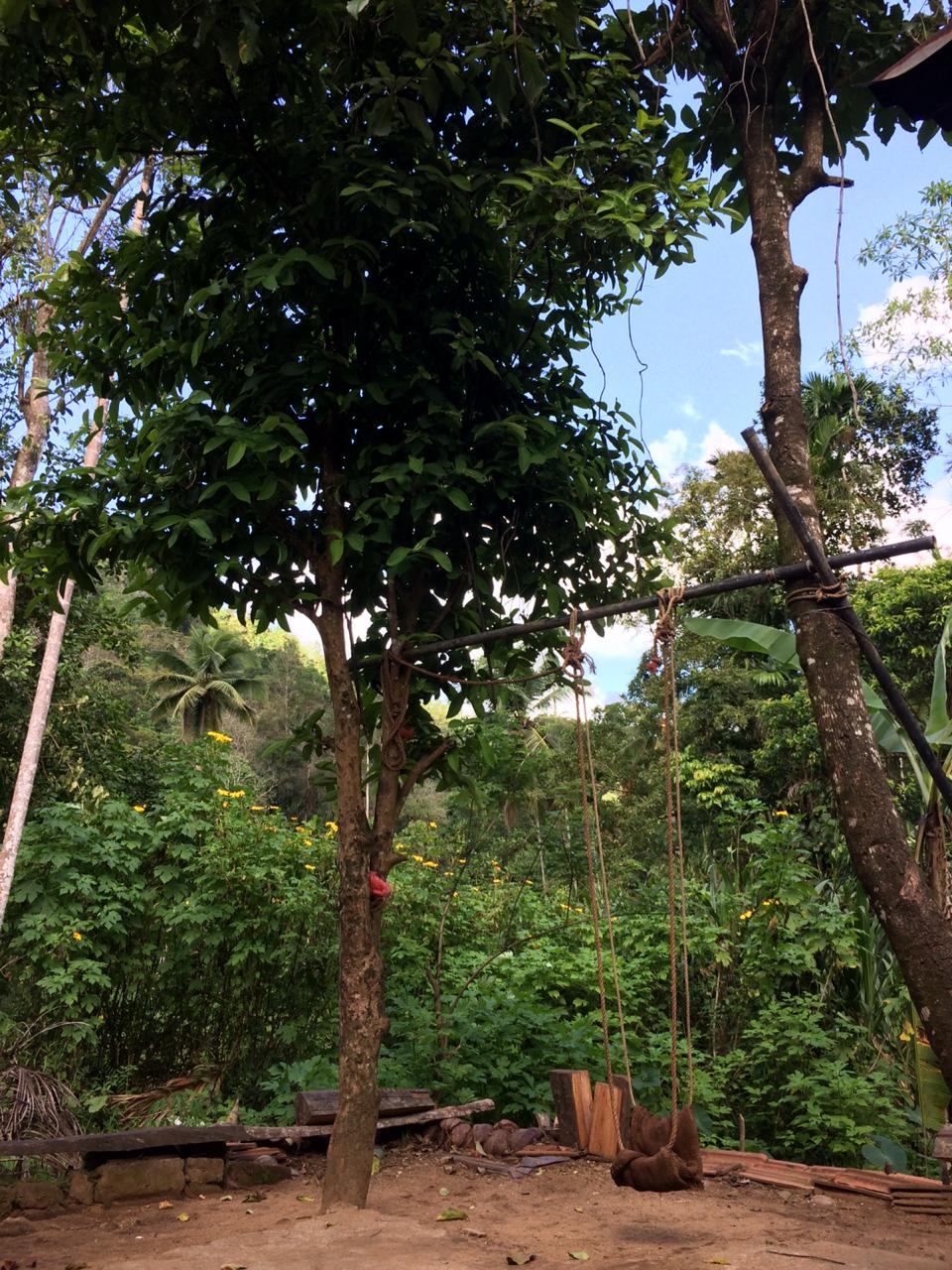
In this sense, the home garden is kind of like one of those snazzy hairdos that require hours of intricate styling and shaping in order to perfect that ” messy beach hair look”. The seemingly haphazard arrangement of vines and trees is actually the result of careful manipulations over time. Branches are tied and trained to grow in directions that are more aesthetically pleasing or to better suit the needs of the homeowner. Vines are trained to grow in desired directions and not to smother other sensitive species (Figs. 2, 3). Trees are primed to accommodate the size of the garden. An amba (mango – Mangifera indica) tree close to the home is primed to stay low, which avoids the risk of it falling on the home during a wind event, but also keeps fruit within arm’s reach. Meanwhile, a jak (Artocarpus heterophyllus) growing just a bit further away is allowed to grow to its full height to provide the combined benefits of shade, fruit, and the eventual timber which is said to make for beautiful window and door frames. Unruly shrubs are weighed down with stones (or batteries) and a piece of string to direct the growth of branches. Sometimes leisure is factored into the design, as was the case where a bench was fitted into the low branches of an ambul pera (guava – Psidium guajava) tree for the children to sit in (Figs. 4, 5). The maintenance of these gardens is not constant, but it is ongoing and dynamic; a continuous series of observations, interactions, and decisions (economic, ergonomic, and aesthetic) are made to maintain this beautifully jungly messy up-do of a garden.

 slpfc.org