
By Akshay Surendra
Sinharaja Biosphere Reserve, south-west Sri Lanka
May 2021
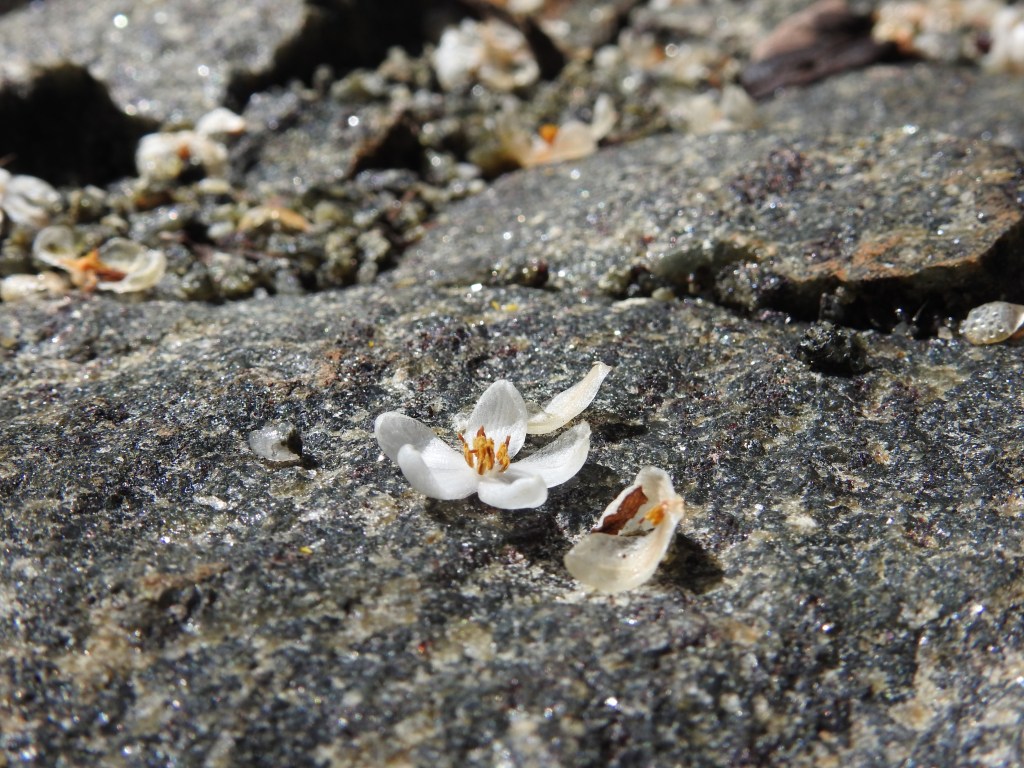
Shorea trapezifolia (Dipterocarpaceae, section Doona) is an endemic canopy tree that forms gregarious stands in valleys and lower slopes of hill dipterocarp rainforests in Sri Lanka.
Shorea trapezifolia belongs to the “Tiniya-dun” group of Shorea species, all of whom are soft wooded, highly resinous (“dun” = resin in Sinhala) and have relatively small, inedible seeds. These traits differ sharply from Shorea species in the “Bereliya” group – these are hard-wooded with low amounts of resin but slightly larger edible seeds. The most striking difference however, is in their flowering and fruiting patterns. While Tiniyas fruit annually, Bereliyas fruit supra-annually, with peak fruiting years coinciding with strong El-Nino events.
Tiniyas stagger their fruiting ever so-slightly, with different species (Shorea affinis, Shorea trapezifolia, Shorea zeylanica, Shorea congestiflora) fruiting at slightly different points in time in the same season.
Bereliyas on the other hand follow the predator-satiation strategy, with all species (Shorea megistophylla, Shorea worthingtonii, Shorea disticha, Shorea cordifolia) fruiting simultaneously in what’s called a ‘masting’ event. Curiously, flowering is staggered in time – this means each Bereliya species takes a different amount of time to mature so they can all synchronize their seed rain when it’s time.


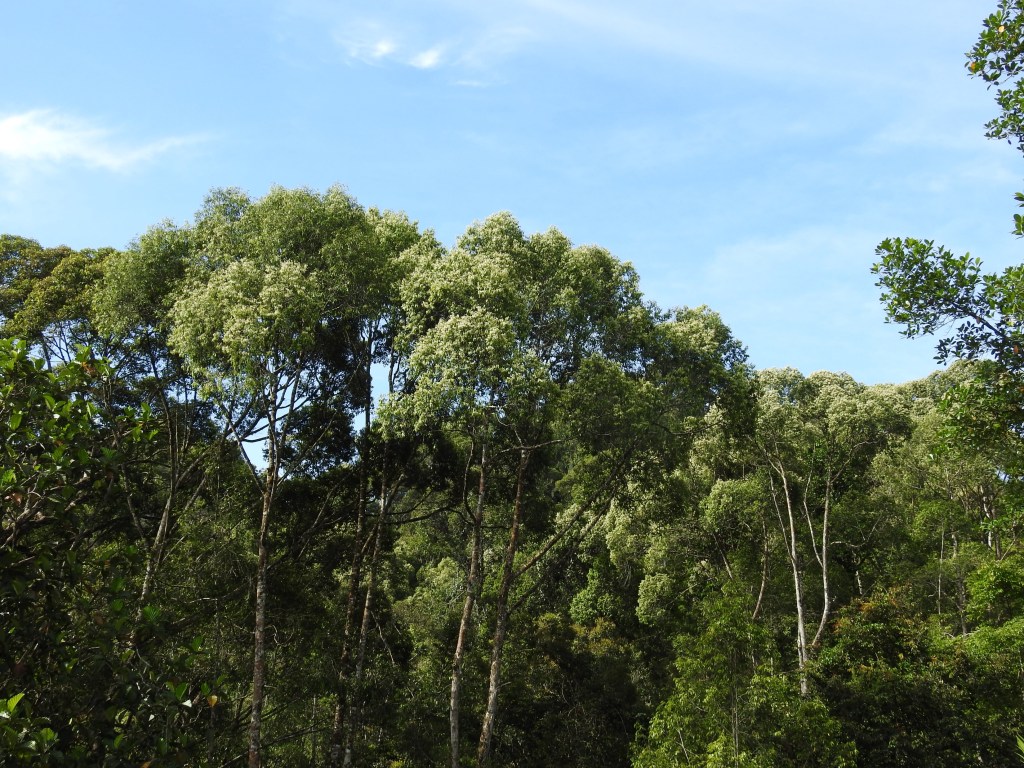
However, Tiniyas show mast-like patterns, flowering and fruiting more profusely in some years than in others – this year, Shorea trapezifolia flowering was particularly copious.
In the first week of May 2021, entire hillsides lightened up as clumps of large Shorea trapezifolia trees decked themselves with millions of tiny white flowers.
Note the absence of white flowers on Mulavella peak in the background, with white-topped canopies petering out as you go up the slope.

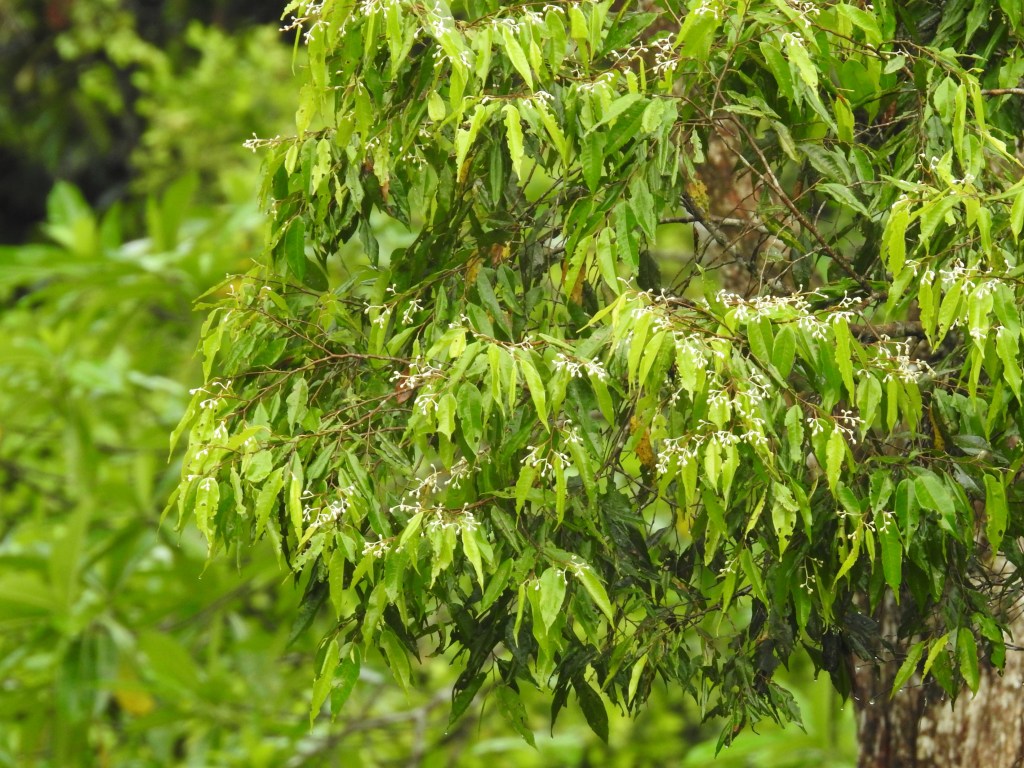
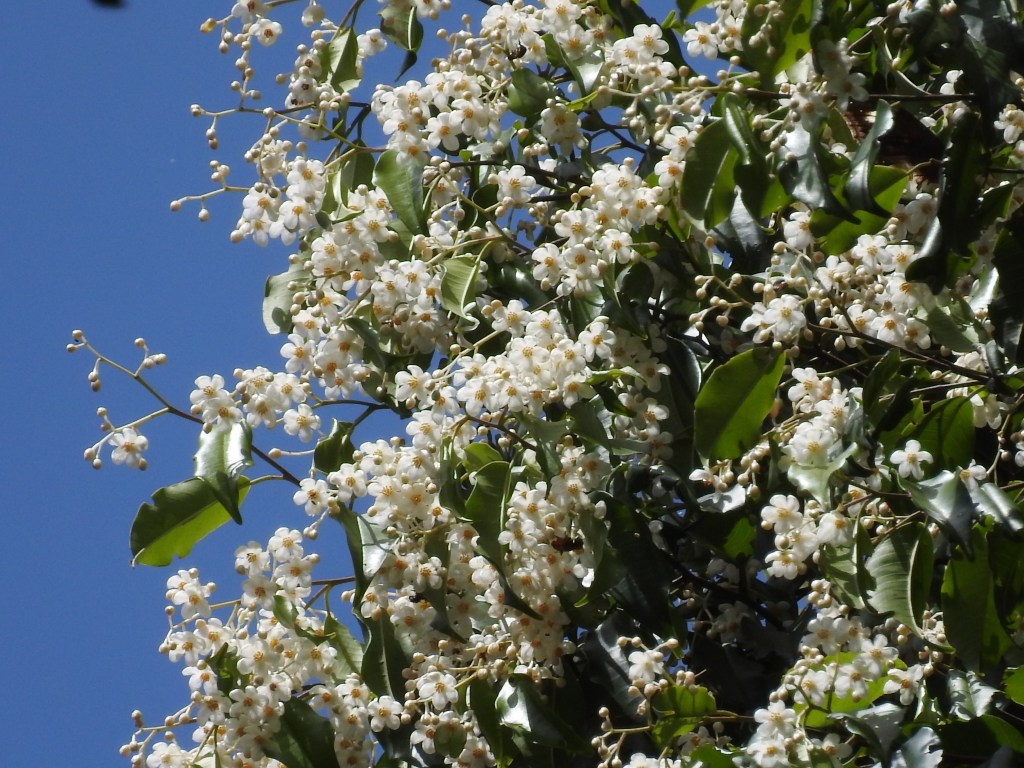
The entire flowering period is compressed into one week. Everyday during this brief period, one set of buds unfurl around 8 am, stay open for about six hours, and fall en masse like steady rain at around 2 pm. The next day, a different set of buds unfurl: at no point do all the buds in an inflorescence open simultaneously, no doubt a bet-hedging strategy to protect against chance events like torrential rain.
Trees must make the most of the brief six hours when flowers are open. They achieve this using strong visual cues, drawing in pollinators from across the landscape and then directing them towards white flowers against a green background. In addition, flowers emanate a mild aroma that accumulate in numbers and sweeps through the forest.
While the most important pollinators are bees, the visual and olfactory cues also attracts undesirable attention: tiny beetles, giant squirrels and langur monkeys all eat flowers without pollinating them, but thankfully the bees far outstrip these interlopers in numbers and effort.
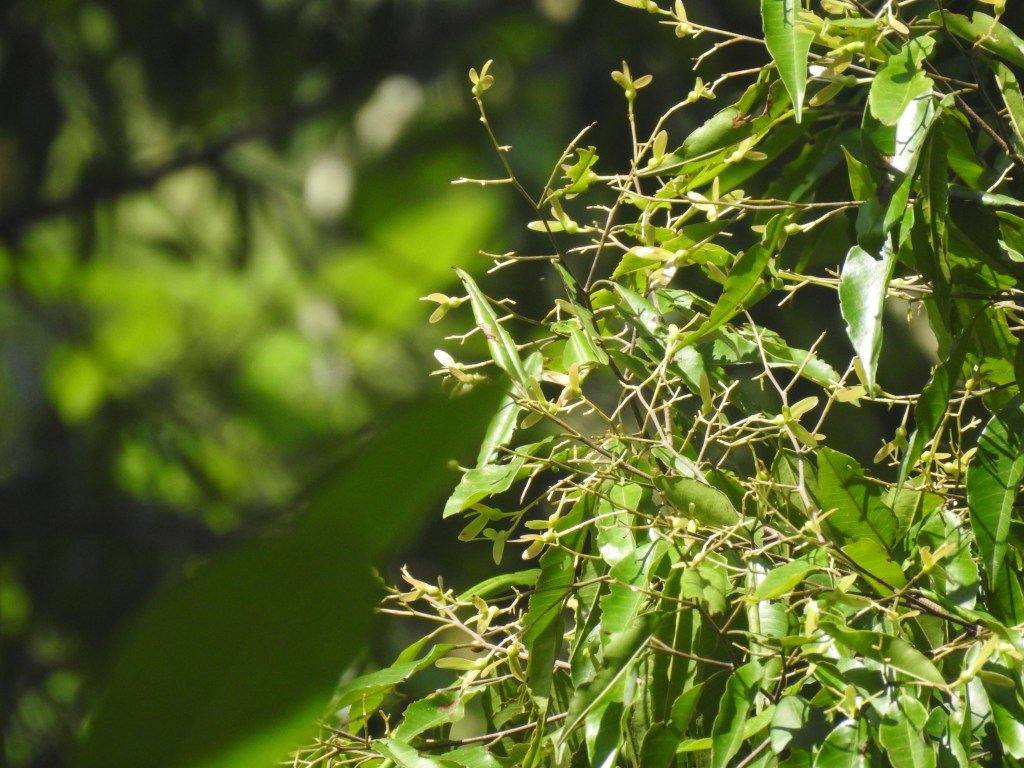
Once pollinated, the petals and the stamens fall to the ground, creating vast dull-white carpets of spent flowers. The sepals quickly wrap around the fertilized stigma and the process of fruit production begins. Within three weeks, the characteristic three-winged fruit is visible.



Some changes over twelve years have been dramatic: the patch of open land where the first photo was taken is now covered in weedy ferns and early successional species like Alstonia macrophylla. Yet the rest of the old-growth forest is nearly identical – large S. trapezifolia individuals in the foreground continue to flower.
A small clump of giant Shorea trapezifolia trees are flowering against a disturbed mountain side: when large patches of forest are disturbed, vegetation does recover quickly but old-growth species – those that store the most carbon and support most diversity – are slow to recover, even when remnant trees persist in the landscape.


Photos and text: Akshay Surendra
Field support: Upul Shanta
Idea and motivation: Prof Nimal Gunatilleke
Source for all natural history information and scientific insights:
1) Two articles by Savitri Gunatilleke and Nimal Gunatilleke –
•Pollination secrets of canopy giants in the Sinharaja Forest
•Reproductive biology & population genetics of some canopy- & understory-dominant tree species in Sinharaja
2) Experience and anecdotes of B.W. Gunasoma
 slpfc.org